You Mean I Could Save Time And Have My Players Help Make My TTRPG Campaigns?

I have managed, somehow, to give people the opinion that I was a great Dungeon/Game Master (GM)*. I've had a couple of people recently refer to me running TTRPGs as if I was some accomplished professional, and it made me laugh. Clearly, those people have never actually played in any of my games. I'm sure all GMs probably feel the same way that I do, but I feel like describing me as "mid" is probably doing a lot of heavy lifting.
*Note: For the rest of this article, I'm just going to use GM, since its more generic to several games, AND because it's literally in the name of the book I'm talking about
Probably because of those peoples' comments, along with some events our local game store has been running to connect GMs, I've been highly motivated to "Up my game" when it comes to running RPGs. There are tons of books out there with information on improving as a GM, and some of them I technically already own! There's been quite a few humble bundles/itch.io bundles and Kickstarters that I've backed with different ideas and opinions on running games, so it's time for me to crack them open and read them.
But first - let's talk about a newer book (Ha, got you)! Around the time that I was having these imposter syndrome thoughts/drive to improve, I was contacted by Media Lab Books, publishers of "The Game Master's Book of" series. Most of the series are books filled with tables of random encounters, puzzles, villains, etc. Some of the newest entries to the series are The Game Master's Handbook of Collaborative Campaign Design and The Game Master's Deck of Wild Magic & Mischief, both of which were provided to me to review.

The cover of The Game Master's Handbook of Collaborative Game Design (written by Jonah & Tristan Fishel) proclaims that the book is "A game-changing approach to homebrewing emergent TTRPG stories, character arcs and worlds with your players." That's quite a promise – and also co-incidentally exactly the type of thing that I'm looking to work on getting better at. Before getting into the nitty gritty of exactly what the book goes over, I can start off by saying this book was extremely pleasant to read. The prose in the book is simple, and the authors often make use of popular movies and books to help illustrate the story principles they are attempting to explain. That type of writing is very much my jam.
Take it back now, y'all

So how do you get started with Collaborative Campaign Design™? Session Zero, right? That's what all the Smart™ people online tell you to do. Wrong! In the Game master's Book, the authors have you take a step back from Session Zero, using an idea called "Session –1". This is where you sit down with players to get ideas and inspirations on the game you all want to play in. Granted, before you do that, the GM will want to brainstorm a bit beforehand, to figure out what game system they want to use, and establish what the book calls "Givens" - what types of content you want to use in the game (any pre-written adventures, guides, items, monsters, etc.). But don't do much more than that! The goal is to have most of the initial worldbuilding happen at the table, giving everyone a voice.
We're not even talking about PCs at this point. Together, the players and the GM work to establish the tone of the game, creating "Genre Statements" like "Charming Magical Realism Heist" or "Optimistic Solarpunk Death Race". Some of the concepts about the tone of the game might be things that other groups/games establish in Session Zero, but in this book they are getting broken down even further. Literally, you start off by having everyone go around and talk about what kinds of media they like to consume, and then talking about *why* you enjoy those pieces of media. Those discussions are what go into creating that genre statement.

It's poor timing for me, as I've recently started a couple of different RPGs, and it would be really cool to test out these concepts and see how they work. I really like the idea of "Session –1", because by tailoring the game to aspects that everyone enjoys, you are sure to get more player interest in the game. I also think that this concept would be easier for having newer people try and GM games, because it offloads some of that initial prep work onto the players. I've been using the Decuma deck that I kickstarted a while ago to help with collaborative world building at my tables recently, and its resulted in a much more fleshed out background than I ever could have come up with by myself. So the techniques and principles are sound, this book just provides more prompts and questions to help GMs.
One hop this time

Instead of coming up with a plot, "emergent campaigns" - a shorter way of describing the type of storytelling this book presents, revolve around character arcs. I always hear people talk about having character arcs in games, but this book uses that as the driving story telling device. Then, the plot falls out from how the characters interact with those arcs. So your players can't accuse you of "railroading a plot because you failed as an author" (a very specific claim that I *totally* have never been accused of before), because you don't always know where the next piece is going. For emergent campaigns, you set up obstacles and conflicts for the players, and let the chips fall to see how the characters bring those conflicts to meaningful conclusions.
The book doesn't just present these ideas and tell you to go have fun. The authors break down character arcs into different categories and pull from popular fiction (like I mentioned above) to give you examples of these types of arcs that you are already familiar with. Once you have ideas for what type of arcs to use, the next step is designing encounters for the players. We aren't planning our games around "sessions", we're breaking down and using "encounters" as the key unit of measure for our stories. This also helps ground you as the GM and keep you from wanting to plan out longer storylines. Focusing on the next encounter and how that will affect the following encounter keeps the players involved in the creation of the story, and helps them feel as if they are having a big impact on the story (because they are!)

Ok, so we need to base our games around encounters – ok time to roll credits, right? Nope, just as before with character arcs, the authors then talk about all the different types of encounters that you could feasibly have in a RPG session. There are ideas in this book to make just about any type of encounter about 10x better. Even travel encounters – in fact, this book has some of the best ideas I've read for making travel encounters more fun (no, I'm not going to tell you them – go read the book!).
Let's go to work
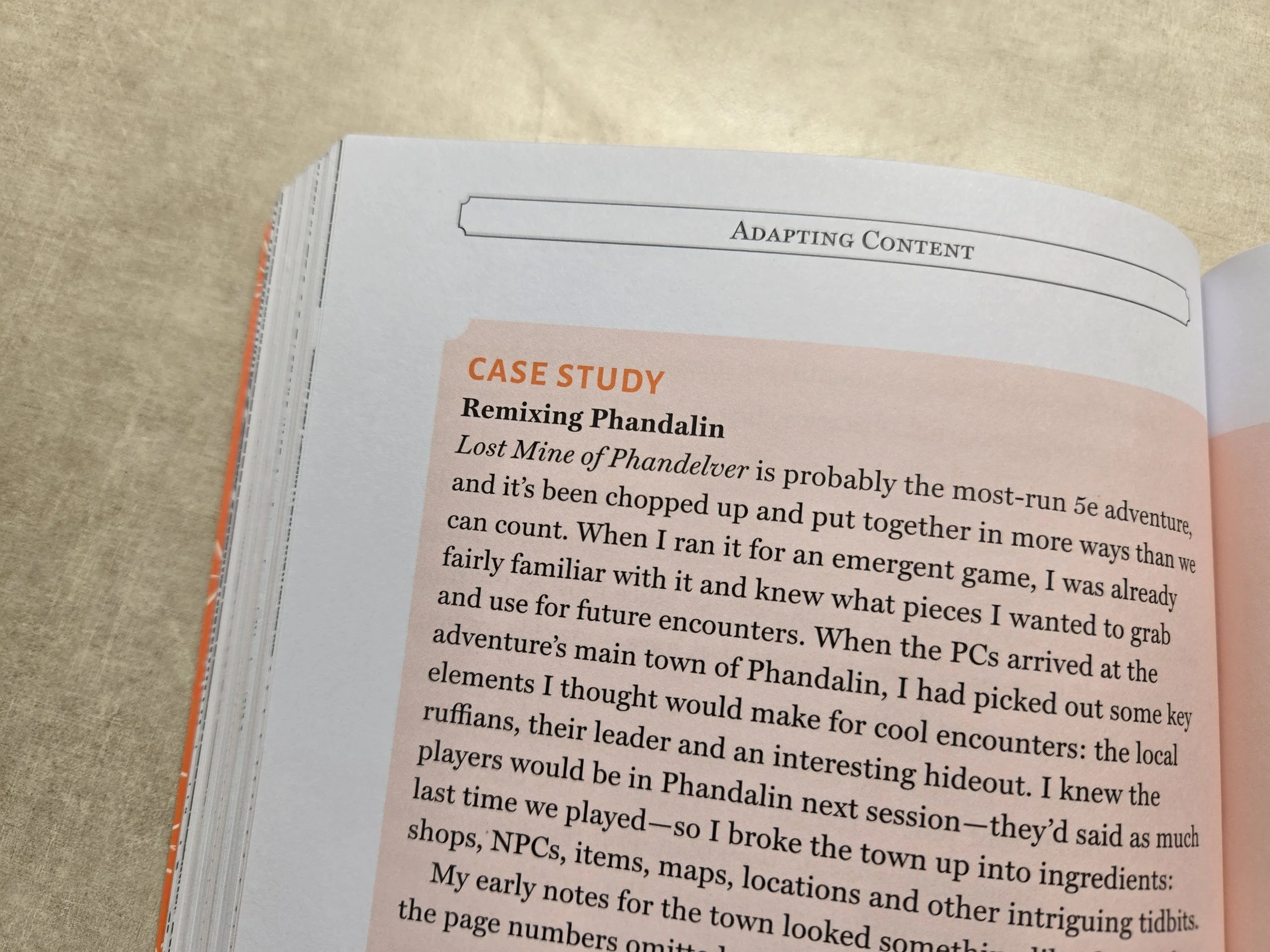
What if you don't want to do a whole "emergent campaign"? What if your group *really* wants to play Curse of Strahd? Or some other pre-written adventure? Or maybe you are still really new to GMing so you want to run a pre-written adventure, but you like the idea of using some of these collaborative techniques? Chapter 5 of the book is dedicated to tips on how to use these techniques with other adventures, but just about each chapter of the book ends with talking about applying the skills discussed in A) homebrew campaigns, B) a published module in a brand new campaign, or C) a published module in an ongoing campaigns. So there's no excuse for trying out some of these pieces.
Given that we are working on the plot with the players and not coming up with it behind the scenes, you would think that some of the details could get complicated fast. You'd be right – with the players interacting with different factions and NPCs, keeping the various plot threads and schemes that are going on behind the scenes can add up quickly. One of my favorite suggestions from this book helps out with this, and it's no wonder it's my favorite because they stole it right from one of my favorite games: clocks from Blades in the Dark (they give credit to the game though). By taking your obstacles and listing out each faction and using a clock to represent those factions progressing their schemes, you can easily help organize encounters to know what's coming next.

There's also some side benefits to this technique that are pretty diabolical. Players fail a skill challenge? Fill in a couple of slices on one of the clocks. Got a skill check or encounter that players *need* to pass to move the story forward? If the party rolls terribly, have them pass the check anyways, but then behind the scenes, advance forward some clocks. Now we've not let mechanics bog down the story, but instead we're using failure as a mechanic to advance what some of the adversaries are doing. It's conniving on a whole other level, and I love it.
Everybody clap yo hands

Another place I tend to suck at with RPGs is coming up with endings. For whatever reason, they don't always seem to work at the table as good as you think they would when you are dreaming them up. Chances are, it turns out, I'm probably trying to force an ending too soon. In this book, the authors provide 5 questions on how to set up a finale for your emergent campaigns. If you look at those questions and can't come up with good answers for them, then clearly there is more campaign that needs to happen first.
Once again, the authors draw upon examples in fiction to show how these 5 questions break down in the context of those stories. It provides some extra layering for these techniques that help make them easy to understand as you read them. If you aren't ready for a finale, but know you need to be for some reason, there are even strategies for how to speed up/slow down the campaign so you can get to the finale when you need it to.

In the very end of the book, there are several Appendices that go along with each chapter of the book. Reference tables give you ways of coming up with consequences for encounters, questions to ask when you are coming up with your genre statements, even questions to help fill out details on the various NPC factions you and your players are coming up with. I've definitely been using some of these tables for my own games to help flesh out factions and make them feel more real in my games. I'm not sure if I'll ever use it, but one of my favorite tables in the back has ways of using "Texas Hold'em" rules to randomize what kind of loot players find - I'm a big fan of the chaos implied there.
Now it's time to get funky

Speaking of utter chaos, let's talk briefly about The Game Master's Deck of Wild Magic And Mischief, the other item sent to me by Media Lab Books. This product is pretty specific to games that are playing D&D 5th edition, although you could probably adjust it to fit other fantasy RPGs with a bit of work. The deck consists of 40 tarot sized cards, each adorned with some pretty amazing artwork. The deck also comes with a book that describes what each of the cards represent. Each card has a different "fount" of magic on it, and by shuffling up and drawing one of these cards, you can slightly alter your 5e combats in many different ways.
Each card has an ongoing effect that affects everyone at the table (constructs have to roll a check or they start to dance, all movement speeds increase but also all attacks do fire damage, etc.) Then, there's a Surge of Power / Surge of Hope. Surges of Power trigger on natural 20s, which provide some cool awesome ability and also cause a new card to draw. Surges of Hope trigger on natural 1s, which provide a neat little boost to help characters down on their luck.

In case you've not listened to the podcast recently, I've started DM'ing 5th edition D&D for kids at our local game store. This deck is perfect for them – they are little balls of chaotic energy anyways, so why not shake things up a bit? My only complaint is that while having full art cards look really nice, a part of me wishes all the information on what the cards do was on the cards instead of having to reference a book. Especially given the small format of the book (to fit inside the deck box), it makes it awkward to pull up the page to remind yourself what the card effects are.
Conclusion
This book is great, if you haven't gathered by now. The whole "collaborative campaign design" will not work with every group, but there is good advice in this book that will help just about any game be better, no matter what system you are running. And it should seem pretty obvious, but games where players feel that they have more of an input into the story are games that players are going to be more inclined to find ways to attend.
Did I mention that the book is only $14.99?! Jonah and Tristan Fishel also wrote a book before this one, "The Game Master's Handbook of Proactive Roleplaying", and after reading this book, I'll be making sure I consume that book too.
What should I read next? My imposter syndrome is in overtime, so I'm consuming just about anything to make my GM'ing better.
Notes/Disclaimers: I generally assume I know nothing. So if I've missed something, let me know in the comments. If you like these types of posts, consider subscribing to our patreon. Lastly, thanks to Media Lab Books for providing a review copy of the book & deck.